

Comprehensive Guide to Ball Materials in 2 Pc Ball Valves: Performance, Metallurgy, and Selection
Nov 04, 2026
Leave a message
Introduction to 2 Pc Ball Valve Architecture
In industrial fluid control systems, the selection of component materials directly dictates operational longevity, zero-leakage performance, and total cost of ownership. Among the various multi-piece quarter-turn designs, the 2 pc ball valve represents one of the most widely deployed configurations across chemical processing, water treatment, and high-pressure liquid lines. The structural design of a two-piece valve features a body split into two housing components, threaded or flanged together, encapsulating the internal ball, valve stem, and polymeric seats.
At the center of this fluid control mechanism is the spherical ball itself. As the primary closure element that rotates 90 degrees to permit or halt fluid flow, the mechanical properties and metallurgical composition of the ball material are paramount. A clear understanding of how ball material selection interacts with system pressure, temperature limits, medium corrosivity, and elastomeric seat compliance is critical for plant engineers and procurement specialists.
Metallurgical Breakdown of Ball Materials in 2 Pc Ball Valves
The overwhelming majority of industrial 2 pc ball valves utilize austenitic stainless steel for the internal ball element due to its superior mechanical strength, resistance to pitting, and compatible surface-finishing properties.
304 Stainless Steel (UNS S30400)
Austenitic 304 stainless steel contains approximately 18% chromium and 8% nickel. The presence of chromium enables the immediate formation of a self-healing, microscopic chromium oxide (Cr2O3Cr_2O_3Cr2O3) passive film upon exposure to oxygen. This passive layer shields the underlying metal from aqueous oxidation and general corrosion.
In standard industrial fluid control applications, a 2 pc ball valve [http://enleadtek.com/products/2-pc-ball-valve.html] equipped with a 304 stainless steel ball provides exceptional operational performance. It is suited for non-corrosive liquids, municipal water handling, low-pressure steam, compressed air, and inert gas lines. Because 304 stainless steel exhibits high tensile strength and ductile resistance, the spherical ball maintains structural integrity without deforming under standard working pressures up to 1000 WOG (Water, Oil, Gas).
316 Stainless Steel (UNS S31600)
For aggressive chemical media, marine operating conditions, or high-chloride environments, 316 stainless steel is the preferred industry standard. The primary chemical difference lies in the addition of 2% to 3% molybdenum. Molybdenum substantially increases the material's resistance to localized chloride pitting, crevice corrosion, and stress corrosion cracking.
When fluid streams contain brackish water, dilute acids, or organic chemicals, using a 316 stainless steel ball valve [http://enleadtek.com/products/316-stainless-steel-ball-valve.html] ensures that the internal ball surface remains uncompromised over long service lifecycles. Maintaining an unpitted, ultra-smooth surface profile on the ball is vital to prevent premature tearing of soft PTFE or RTFE valve seats.
Alternative Materials and Surface Treatments
While 304 and 316 stainless steel dominate industrial inventory, specialized applications may require specific metallurgical variants:
- 316L Stainless Steel: Featuring a reduced carbon content (below 0.03%), 316L minimizes carbide precipitation during welding processes, making it ideal for high-purity or hygienic fluid transport.
- Chrome-Plated Carbon Steel: Found occasionally in low-cost utility valves. However, electroplated chrome layers are susceptible to flaking and localized pinhole corrosion under thermal cycling. As a result, solid austenitic stainless steel remains the superior engineering choice.
- Duplex Stainless Steels (e.g., 2205): Applied in off-shore oil facilities where high mechanical yield strength combined with extreme resistance to chloride stress cracking is mandatory.
Engineering Considerations: Surface Finish, Roundness, and Seat Compatibility
The performance of a ball valve does not rely solely on chemical composition; microscopic manufacturing precision plays an equally essential role.
Sphericity and Surface Roughness
To achieve a bubble-tight seal according to API 598 or EN 12266-1 standards, the internal ball must be precision-machined using advanced CNC equipment and polished to a mirror finish. Typical surface roughness (RaRaRa) values for high-performance balls range from 0.2 to 0.4 micrometers (0.2–0.4 μm0.2–0.4\ \mu m0.2–0.4 μm).
If the ball surface exhibits micro-roughness or spherical deviation exceeding tight tolerances (typically within 0.005 mm0.005\text{ mm}0.005 mm roundness), the continuous rotational friction against the polymeric seat creates micro-scratches on the soft seating face. Over consecutive actuation cycles, these scratches develop into micro-leak paths, resulting in seat blow-by and internal leakage.
Tri-Tribological Interaction with Valve Seats
The ball material must function harmoniously with the surrounding seat inserts. Common seat materials include:
- Standard PTFE (Polytetrafluoroethylene): Offers low friction and broad chemical inertness up to 180°C.
- RTFE (Reinforced PTFE): Glass-filled or carbon-filled PTFE offering higher mechanical strength and creep resistance under elevated pressures.
- PEEK (Polyetheretherketone): Used in extreme temperature and high-pressure environments where high mechanical hardness is required.
Austenitic stainless steel balls maintain an optimal hardness differential when paired with PTFE and RTFE seating elements. The smooth metal surface glides against the polymer without causing abrasive wear, preserving low operating torque throughout thousands of 90-degree rotational cycles.
Matching Ball Valves to Specific Application Demands
Different piping layouts require specialized two-piece valve configurations. Ensuring material compatibility across all internal components guarantees system integrity.
For industrial plants requiring physical isolation mechanisms to prevent inadvertent valve actuation during maintenance, utilizing a locking stainless steel ball valve [http://enleadtek.com/products/locking-stainless-steel-ball-valve.html] equipped with a 304 or 316 ball ensures compliance with industrial safety and lock-out/tag-out (LOTO) protocols.
In piping systems where male-to-female thread transitions are necessary to minimize overall fitting lengths, a male female ball valve [http://enleadtek.com/products/male-female-ball-valve.html] with a precision-machined 304 stainless steel ball provides a compact and leak-free fluid control point.
When pipelines undergo diameter transitions to manage flow velocity or pressure drop across equipment manifolds, a reducer ball valve [http://enleadtek.com/products/reducer-ball-valve.html] configured with a high-grade 316 ball maintains uninterrupted flow control while offering maximum corrosion resistance against process chemicals.
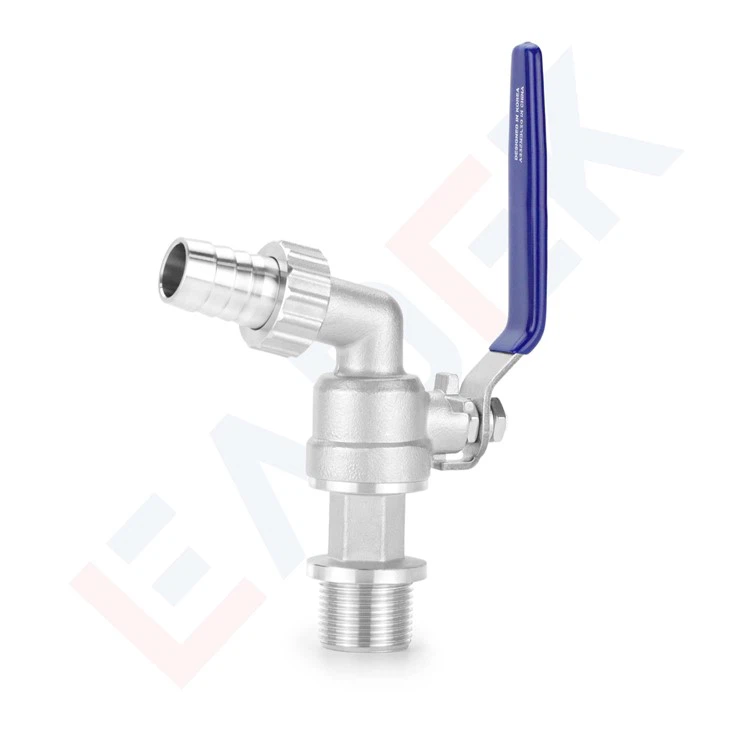
For space-constrained installation spaces requiring directional flow changes within a 90-degree envelope, implementing an elbow ball valve [http://enleadtek.com/products/elbow-ball-valve.html] eliminates extra pipe elbows, streamlining flow control and reducing potential leakage joints in the system.
Conclusion: Quality Assurance in Ball Material Selection
The operational efficiency and sealing capability of a 2 pc ball valve depend fundamental upon the material integrity and machining quality of its internal ball. Selecting between 304 and 316 stainless steel requires evaluating fluid chemistry, temperature variations, environmental exposure, and system pressure.
Specifying solid, high-precision austenitic stainless steel balls paired with quality PTFE or RTFE seats guarantees low operating torque, zero-leakage sealing, and long service life in demanding industrial fluid applications.