

Sanitary Clamp Fittings In Lithium Battery NMP Recovery Systems: Hygiene Standards That Carry Over
Nov 13, 2026
Leave a message
Introduction: A Problem Engineers Didn't Expect to Have
When a lithium battery coating line goes down for unplanned maintenance, the culprit is rarely the dryer or the coater itself. More often, it's something smaller - a leaking pipe joint, a gasket degraded by NMP exposure, or a connector that traps solvent residue and introduces trace contamination into the recovered liquid. Engineers who have managed NMP recovery systems for even a few years recognize this pattern immediately.
N-methyl-2-pyrrolidone (NMP) - the solvent used to dissolve PVDF binders during cathode electrode coating - is aggressive. It attacks inadequate materials, permeates poor seals, and leaves crystalline deposits inside any pipe geometry that creates flow stagnation. As cathode manufacturing lines scale from pilot capacity to full GWh production, the piping and connection hardware that links coating ovens to condensers, storage tanks, and distillation units increasingly determines whether recovery rates stay above the 95% threshold that makes closed-loop solvent reuse economically viable.
The engineering community has largely solved this problem in a different industry first. Food processing, pharmaceutical manufacturing, and bioprocessing facilities have spent decades designing fluid systems that must handle aggressive cleaning chemicals, maintain purity under thermal cycling, and be dismantled and reassembled frequently without compromising integrity. The hardware they developed - specifically, the stainless steel sanitary clamp - carries a set of design principles that transfer directly to the NMP recovery challenge.
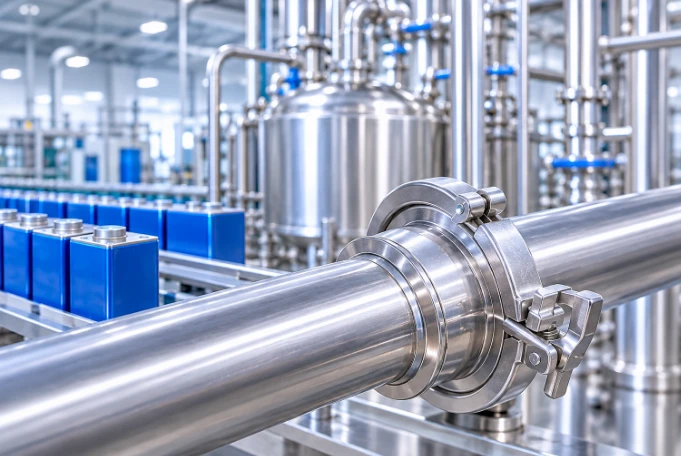
Sanitary Tri-Clamp fittings for clean and reliable NMP recovery
Why Conventional Industrial Fittings Fall Short in NMP Systems
Standard carbon steel or even basic stainless threaded fittings present three specific failure modes in NMP service:
Crevice contamination. Threaded connections and standard flanged joints create recessed areas where NMP concentrates during partial evaporation cycles. At the condensation temperatures typical in recovery systems (60–90°C), these pockets accumulate polymer residue from the PVDF binder carried over with the solvent vapor. Over weeks of operation, these deposits narrow effective bore diameter and become a source of particulate contamination in recovered NMP - directly degrading the purity of recycled solvent below the electronic-grade threshold required for reuse in electrode slurry.
Gasket incompatibility. Many general industrial gasket materials - rubber compounds, compressed fiber - swell, harden, or leach plasticizers when in sustained contact with NMP. A gasket that passes a 72-hour soak test at room temperature may fail within 500 operating hours at 120°C. The resulting micro-leaks not only release NMP vapor into the workspace (a regulatory concern, since occupational exposure limits for NMP are set at 10 mg/m³ under EU REACH) but also allow air infiltration that disrupts the solvent balance in condensation stages.
Maintenance access. A typical NMP recovery system handling a 4,000 m³/h coating line requires inspection and cleaning of condensers and liquid collection points every 2–4 weeks. If pipe connections require wrenches, pipe dope, or re-torquing to specified values, maintenance intervals extend and human error increases. Each re-assembly with traditional fittings introduces the possibility of misalignment and uneven gasket compression.
The Hygiene Logic Behind the Stainless Steel Sanitary Clamp
The stainless steel sanitary clamp - also called a tri-clamp or Tri-Clover connection - was engineered to solve exactly these categories of problems, albeit originally in food and pharmaceutical settings. The engineering principles it embodies are not industry-specific; they are responses to universal fluid-handling challenges that NMP recovery shares.
The connection geometry is defined by two mating ferrules, a gasket, and a hinged clamp band. When the clamp is tightened, it draws the ferrule faces together against the gasket with controlled, even compression - compressing the seal approximately 0.3 mm, no more. The inner bore is fully continuous, smooth, and free of any recess or dead leg. This is not cosmetic. It is a deliberate design to prevent the accumulation of product residue at connection points.
Material specification reinforces the geometry. 316L stainless steel - the standard for sanitary service - contains a higher molybdenum content than 304, which significantly increases resistance to chloride and organic solvent attack. For NMP service specifically, 316L provides stable passive layer behavior across the temperature range of recovery operations (ambient to 150°C) without the pitting susceptibility that makes 304 problematic in prolonged solvent contact.
Surface finish is the third element. Sanitary standards require internal Ra values at or below 0.8 µm (with pharmaceutical-grade BPE specifications going to 0.38 µm). At these finish levels, NMP residue and polymer deposits do not adhere effectively to the pipe wall during normal operation, and what does accumulate is removed by standard solvent flush procedures - no mechanical scrubbing required.
The Sanitary Tri Clamp in Practice: NMP System Integration Scenarios
Understanding the value of the sanitary tri clamp in NMP systems is clearest through specific integration points.
Condenser outlet connections. The outlet of a surface condenser where NMP vapor transitions to liquid is a high-fouling location. Temperature differentials cause repeated wet-dry cycling, and polymer binder carried from the dryer exhaust concentrates here. A sanitary tri clamp connection at this point allows the downstream collection pipe to be detached, drained, and inspected in under three minutes without tools. Conventional flanged connections at the same location may require 20–30 minutes of wrench work and are rarely serviced at the intervals actually needed.
Storage tank inlets. Recovered NMP storage tanks typically have multiple inlet points - from condensers, from distillation bottoms, from rework batches. Each connection is a potential contamination point if crevice geometry allows residue accumulation between fill cycles. Sanitary ferrule connections with PTFE or EPDM gaskets (both rated for NMP service) eliminate this risk while enabling rapid disconnection during tank cleaning.
Sampling ports. Quality control of recovered NMP purity requires frequent sampling - typically daily on a production line, more often during system commissioning. Sanitary clamp-style sample valves provide a clean, drainable connection point that does not introduce the sampling bias common with traditional valve designs, where dead-leg volume between the valve and the process line contaminates the sample with aged material.
A well-specified NMP recovery system in a GWh-scale battery plant may use 80 to 150 sanitary clamp connections across all integration points. At that scale, the consistency of assembly and the speed of maintenance access become meaningful operational factors, not just engineering preferences.
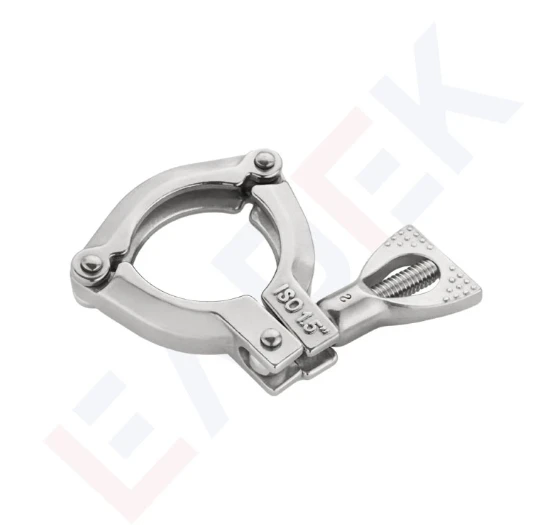
Leadtek Sanitary Tri Clamp
Leadtek: Manufacturer Credentials That Matter in This Application
Specifying the right fitting type is only part of the engineering decision. Supplier reliability determines whether that specification actually holds across thousands of connection assemblies.
Zhejiang Leadtek Fluid Technology Co., Ltd. has been manufacturing stainless steel fluid control components since 1994 - more than 30 years of accumulated process knowledge in precision casting and CNC machining of stainless steel. The company's 37,000 m² production facility in Quzhou, Zhejiang, operates with 400+ advanced machines and a workforce of 300+ engineers, machinists, and quality personnel. Monthly output exceeds 400 tonnes.
Leadtek holds ISO 9001 and ISO 14001 certifications and has obtained 40+ patented technologies across its product range. Its sanitary fittings line - which includes stainless steel sanitary clamps, clamp ferrules, sanitary valves, and the full range of Tri-Clamp system components - is manufactured to 3-A sanitary standards and is supplied to customers in over 80 countries, including established industrial markets in Germany, the United States, Japan, and South Korea.
For battery manufacturing engineers evaluating sanitary clamp fittings for NMP recovery applications, Leadtek offers material traceability documentation, dimensional compliance with ISO 2852 / ASME BPE ferrule standards, and customization capability for non-standard bore sizes or connection configurations required by specific equipment interfaces. The company's R&D team has developed over 100 certified product variants across its valve and fitting lines, with engineering support available for application-specific selection.
Summary: Actionable Recommendations
If you are specifying or upgrading the piping system for an NMP recovery unit on a lithium battery electrode coating line, the following decisions produce the most reliable outcomes:
1. Standardize on 316L stainless steel sanitary clamp connections at all maintenance-access points. Priority locations are condenser outlets, storage tank inlets, sampling ports, and any section of pipe that requires cleaning intervals shorter than three months.
2. Specify PTFE gaskets for primary process connections; EPDM as a secondary option. Both materials have demonstrated compatibility with NMP at operating temperatures up to 150°C. Avoid silicone gaskets in high-temperature NMP service - swell rates become significant above 100°C.
3. Establish a re-inspection interval for clamp torque during the first 90 days of operation. Thermal cycling causes ferrule and gasket dimensional settling. A single re-torque at the first scheduled maintenance window typically resolves any residual creep.
4. Document connection inventory before procurement. A 4,000 m³/h system typically requires 60–100 sanitary connections; a 9,000 m³/h system may need 120–160. Accurate count at design stage prevents the mix of fitting types from different suppliers that creates dimensional incompatibility at ferrule mating faces.
5. Request material test reports (MTRs) from your supplier. For NMP recovery systems supplying solvent back into electrode slurry production, traceability of material composition is a quality audit requirement, not an optional extra.
FAQ
Q: Are sanitary clamp fittings rated for the temperature range of NMP recovery systems?
Standard 316L stainless steel sanitary clamp connections are rated for continuous service from –20°C to 200°C, which comfortably covers the full operating range of NMP condensation and distillation stages (typically 60°C to 150°C). Gasket material selection determines the actual upper limit in practice - PTFE gaskets are rated to 200°C; EPDM to approximately 150°C.
Q: What gasket material should I use for NMP service?
PTFE (polytetrafluoroethylene) is the first choice for NMP service. It is chemically inert to NMP across the full temperature range, exhibits minimal compression set, and does not leach plasticizers. EPDM is an acceptable alternative at temperatures below 120°C. Silicone and Buna-N (nitrile) gaskets should be avoided - both show swelling in sustained NMP contact.
Q: Can existing threaded or flanged pipe sections be retrofitted with sanitary clamp connections?
Yes. Sanitary tri clamp adapters are available to transition from NPT-threaded, BSP-threaded, or standard ANSI-flanged pipe ends to ferrule-type connections. This allows incremental conversion of existing systems at maintenance-access priority points without requiring complete pipe replacement.
Q: How do sanitary clamp connections compare to welded joints for NMP service?
Welded joints provide the highest leak integrity and are appropriate for permanent sections of NMP piping that do not require access for cleaning or inspection. Sanitary clamp connections are the correct choice wherever periodic access is needed. The two connection types are complementary and are typically used together in a well-designed system: welded runs between fixed equipment, sanitary clamp connections at maintenance and inspection points.
Q: What certifications should I look for when purchasing sanitary fittings for NMP applications?
Look for ISO 9001 quality management certification from the manufacturer, dimensional compliance with ISO 2852 or ASME BPE ferrule standards, and material certifications to ASTM A270 or equivalent for 316L stainless steel. For suppliers providing components that will contact recovered NMP destined for reuse in electrode production, full material traceability documentation (MTRs) is the critical requirement.