

How Thread Butterfly Valves Are Reshaping Data Center Cooling Infrastructure
Jul 12, 2026
Leave a message
Data centers are no longer the quiet, air-conditioned server rooms of the early 2000s. Today, a single hyperscale facility can draw 50 to 200 megawatts of power and push heat loads that rival heavy industrial process plants. The explosion of AI computing has been the main driver. Training large language models and running inference at scale produces extraordinary heat at the rack level, with GPU clusters regularly exceeding 100 kW per rack and some liquid-cooled AI deployments pushing beyond 150 kW. That heat must be managed with precision, and the entire burden of managing it falls on the cooling infrastructure.
Valves are not the most glamorous component in a data center, but they are among the most consequential. Every chilled water loop, every cooling tower connection, every pump station depends on valves to control how coolant moves through the system. Among all valve types deployed in modern cooling infrastructure, the Thread Butterfly Valve has earned a central role in main distribution pipelines where large volumes of coolant need to be regulated efficiently and reliably.
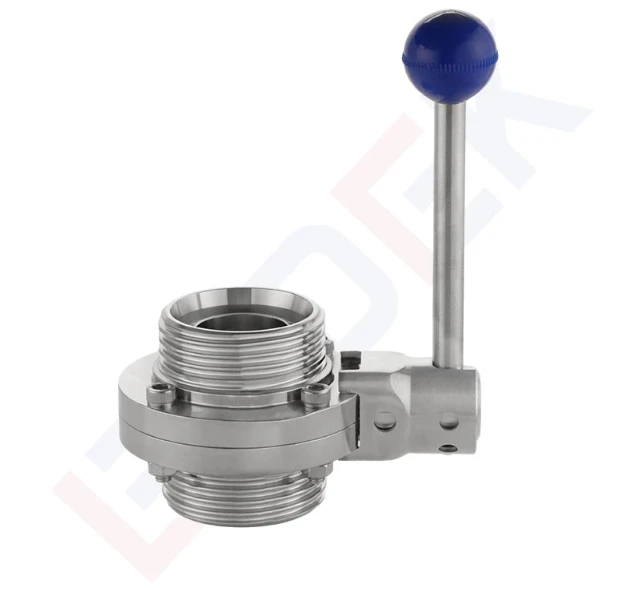
LEADTEK Thread Butterfly Valve
Why Cooling System Design Has Become More Demanding
The shift toward variable primary flow cooling systems has changed what engineers expect from every component in the circuit. In a traditional constant-flow system, pumps ran at fixed speed and valves simply opened or closed on command. In a variable flow system, pumps modulate speed to match real-time cooling demand, and control valves must throttle continuously and accurately to maintain differential pressure setpoints. This places far greater demands on valve performance than simple isolation duty ever did.
At the same time, data center operators are under enormous pressure to reduce Power Usage Effectiveness, which measures total facility energy consumption against the energy actually used by servers. Cooling systems account for as much as 40 percent of total site energy in many facilities. Poor valve selection, undersized actuators, or improperly calibrated control valves translate directly into higher pumping costs, wasted energy, and compressed margins on operating budgets that are already stretched thin.
The selection of the right valve at the right location is, in this context, a genuine engineering decision with real financial and operational consequences.
Where the Thread Butterfly Valve Fits in the Cooling Circuit
A typical hyperscale data center cooling system moves chilled water through a hierarchy of pipelines, starting from the central chiller plant and working outward to cooling towers, plate heat exchangers, cooling distribution units, and ultimately to the server racks themselves. The largest pipes in this hierarchy, the chilled water mains and primary distribution headers, are where the Thread Butterfly Valve consistently proves its value.
Compared to gate valves or globe valves in equivalent sizes, a butterfly valve is substantially lighter, more compact, and faster to operate. In pipelines with nominal diameters of DN200 and above, the cost and space advantages of a butterfly valve over comparable alternatives become increasingly significant. Facility engineers working with constrained plant room layouts appreciate the ability to install a large-bore isolation or control valve without dedicating disproportionate space to the valve body and operator.
The fast quarter-turn operation of a butterfly valve also matters in cooling systems where flow needs to be redirected or isolated quickly in response to a pump trip, a pressure excursion, or a planned maintenance event. The ability to open or close a large-bore valve in seconds, rather than the minutes required to wind a handwheel gate valve to full travel, is a practical benefit that shows up in reduced response times during system upsets.
Types of Thread Butterfly Valves and Their Roles
Not all butterfly valves are equivalent, and selecting the right subtype for each application position requires careful engineering judgment.
Concentric butterfly valves, where the disc and shaft are centered within the pipe bore, represent the most common and cost-effective option for lower-pressure chilled water service. They are widely used on primary cooling loops and cooling tower bypass lines where continuous tight shutoff is not required. The seat material is typically EPDM rubber, which provides reliable compatibility with treated cooling water and glycol-inhibitor packages at concentrations up to around 50 percent. Pressure ratings at PN10 or PN16 are sufficient for most data center HVAC pressure regimes.
Double-offset, or high-performance, butterfly valves introduce two geometric offsets to the shaft that pull the disc clear of the seat as it opens, dramatically reducing seat wear in modulating service. These are the appropriate choice for continuously cycling control applications on variable flow chilled water systems, where the valve must respond to differential pressure controllers throughout every hour of operation. The tighter shutoff characteristics make them suitable for pump isolation and bypass duties where leakage control matters.
Triple-offset butterfly valves take this geometry further with a cam-action disc closure that achieves genuinely bubble-tight metal-to-metal sealing. In data center cooling applications, these are typically reserved for high-pressure chiller bypass positions, emergency shutoff locations on critical cooling headers, and any position where fire-safe performance is a specification requirement. Their predictable actuator torque characteristics make them particularly well suited to electric actuator sizing.
Technical Specification Considerations
Cv ratings and rangeability deserve careful attention when specifying any butterfly valve for modulating duty. The relationship between disc angle and flow coefficient in a butterfly valve is highly non-linear. Useful control authority typically exists between approximately 20 and 70 degrees of disc travel. A valve hunting in the 5 to 15 degree range is not just providing poor flow control. It is also destroying its seat and generating unnecessary noise and vibration in the pipeline.
Valve authority is equally important in variable flow systems. Authority is defined as the ratio of pressure drop across the control valve at full open to the total pressure drop in the circuit including that valve. Authority values below 0.3 indicate that the valve has insufficient influence over flow in its circuit, and control quality suffers accordingly. Many engineers working on large data center cooling projects have moved to pressure-independent control valves for air handler and cooling distribution unit connections, specifically because these devices maintain stable flow regardless of system pressure variation.
Material compatibility is another specification factor that should not be treated as a formality. Most data center chilled water systems use glycol-based inhibitor packages, typically ethylene or propylene glycol at 20 to 35 percent concentration. EPDM seats perform well in this service. PTFE-lined seats provide enhanced resistance for more aggressive inhibitor formulations. Body material should be ductile iron as a minimum, with low-zinc brass or stainless steel trim specified for systems where dezincification presents a long-term corrosion risk.
The Role of the Tri Clamp Butterfly Valve in Advanced Cooling
As direct liquid cooling and immersion cooling systems become more common in high-density data center deployments, a different category of butterfly valve has entered the specification picture. The Tri Clamp Butterfly Valve is designed for sanitary or ultra-clean service, with a hygienic end connection that allows rapid, tool-free disassembly for cleaning and inspection. In single-phase liquid cooling circuits using deionized water, where maintaining fluid purity is critical to protecting server components, the Tri Clamp Butterfly Valve offers practical advantages in serviceability and contamination control that conventional flanged or threaded valves cannot match.
Two-phase immersion cooling systems, where dielectric fluid boils directly off server components and condenses in heat exchangers, represent the most thermally efficient cooling approach currently available at rack level. These systems demand valve designs that can handle vapor-liquid mixtures without cavitation or flow instability, and the compact, low-obstruction geometry of a properly specified butterfly valve is well suited to this duty when the correct sizing methodology is applied.

LEADTEK Tri Clamp Butterfly Valve
Actuator Selection and Integration
The actuator fitted to a modulating butterfly valve in a cooling system is not an afterthought. It is half of the control system. Actuator torque sizing must account not only for static seat sealing forces but also for hydrodynamic torque generated by flow acting on the disc, which peaks at around 60 to 80 degrees open and can exceed static breakaway torque under demanding flow conditions. A safety factor of at least 1.3 times the published maximum torque is appropriate for general service. Critical positions warrant 1.5 times or higher.
Duty cycle specification matters equally. An actuator rated for on/off switching at a given torque rating will overheat if run continuously in modulating service. Specify actuators with a duty cycle matched to the application, and confirm that integral positioners are compatible with the BMS protocol in use at the facility. BACnet and Modbus dominate data center building management system architecture. Fail-safe positioning logic should be confirmed at design stage, with cooling supply valves typically configured to fail open and isolation valves configured to fail closed on loss of control power.
LEADTEK's Manufacturing Capability and Quality Standards
ZHEJIANG LEADTEK FLUID TECHNOLOGY CO., LTD has been building fluid control products since 2015, growing from a precision CNC machining operation in Wenzhou into a full-capability manufacturing enterprise occupying 37,000 square meters of production space in the Changshan Industrial Park, Quzhou, Zhejiang Province. The facility runs more than 400 advanced production machines and employs over 300 people across R&D, manufacturing, testing, and export functions.
The company's product development history includes more than 100 certified ball valve variants and over 40 patented technologies, developed through an internal R&D team that was formed in 2019. International certifications include ISO 9001, ISO 14001, CE, TS, and KC, reflecting a quality management framework that supports export to more than 80 countries and regions across Europe, North America, Asia-Pacific, the Middle East, and South America.
For data center cooling applications specifically, LEADTEK's background in precision stainless steel casting and CNC machining translates directly into the dimensional consistency and surface finish quality that butterfly valve seats and disc geometries require for reliable long-term performance. Tight tolerances on disc profile geometry are what separates a butterfly valve that provides genuine flow control authority from one that merely opens and closes. LEADTEK's manufacturing process controls, developed over more than 30 years of casting experience dating back to the company founder's work in Wenzhou in 1994, support the precision required for cooling system service in mission-critical facilities.

Live shots of the Leadtek factory
Looking Ahead
The data center construction pipeline extending through the next several years represents a significant and sustained demand signal for properly specified cooling valves. Global investment in data center capacity is running at hundreds of billions of dollars annually, and each facility built to accommodate AI infrastructure represents a technically demanding valve procurement requirement. Market analysts project the data center liquid cooling valves market to grow from approximately 270 million USD in 2025 to 1.8 billion USD by 2032, at a compound annual growth rate exceeding 30 percent.
For valve engineers, facility designers, and procurement professionals involved in this sector, the key shift underway is away from commodity specification toward performance-based specification. The question is no longer simply what valve fits the pipe. The question is which valve type, at which offset geometry, with which seat material, actuated by which duty-rated operator, will deliver the control authority, energy efficiency, and service life that mission-critical cooling infrastructure demands. The Thread Butterfly Valve, properly selected and correctly sized, is at the center of that answer in virtually every hyperscale cooling plant being built today.