

Engineering Analysis: Application of Reducing Cross Tees in Pulp and Paper Pipelines
Jun 15, 2026
Leave a message
In the pulp and paper infrastructure manufacturing sector, piping systems are subjected to some of the most destructive chemical and mechanical environments in heavy industry. Transporting pulp stock-a dense, highly abrasive mixture of organic wood fibers, process water, and aggressive bleaching chemicals-demands components with strict resistance profiles.
When evaluating whether a Reducing Cross Tee (a four-way pipe fitting with reduced branch sizes) can be successfully integrated into these configurations, piping layout designers must look beyond general pressure ratings. You must address the exact fluid dynamics and metallurgical integrity of the fitting.
As a premier global industrial manufacturer with over 30 years of vertical integration in stainless steel precision casting and high-accuracy CNC machining, ZHEJIANG LEADTEK FLUID TECHNOLOGY CO., LTD engineering team provides a rigorous technical assessment below.
The Primary Engineering Challenges in Pulp Stock Piping
Integrating any multi-port junction, such as an industrial Reducing Cross, into a pulp process line introduces two primary system risks that standard commercial fittings cannot survive:
1. Erosion-Corrosion from Fibrous Slurries
Wood pulp fibers act as a continuous mechanical abrasive against the inner boundaries of the pipe fitting. At a 4-way junction, the shifting fluid paths generate localized turbulence and eddy currents. This accelerates localized erosion, which strips away the metal's protective passive oxide layer and leaves it vulnerable to rapid chemical attack (Erosion-Corrosion).
2. Fiber Accumulation and Channel Clogging
Pulp fibers have a natural tendency to entangle and dewater in zones with low fluid velocity or structural dead-bands. Standard cast crosses with rough interior surfaces often trigger fiber "hanging," where stock accumulates in the branch recess, eventually calcifying and creating total line blockages or severe pressure drops ($\Delta P$).
How LEADTEK Engineering Solves Pulp Sourcing Constraints
To safely implement Reducing Cross Tees in pulp and paper mills, LEADTEK relies on advanced metallurgical control and precision CNC surface finishing to eliminate these mechanical points of failure:
Austenitic Stainless Steel Selection (316/316L/CF8M)
While Grade 304 is adequate for municipal water supply lines, the pulp bleaching sector requires extensive chemical resistance against harsh compounds like chlorine dioxide, sodium hypochlorite, and black liquor.
LEADTEK utilizes independent precision casting foundries to formulate high-purity Stainless Steel 316 and low-carbon 316L (CF8M equivalent). The presence of 2-3% Molybdenum guarantees superior resistance to chloride-induced pitting, crevice corrosion, and intergranular corrosion during line welding.
High-Precision Interior Boring (CNC Machining)
To prevent fiber hanging and stock accumulation, the inner diameter and flow pathways of every LEADTEK cross fitting undergo rigorous mechanical processing. Operating out of our 37,000㎡ (400,000 sq.ft) smart factory, our technical group utilizes over 300 advanced CNC machining centers. We achieve tightly controlled dimensional tolerances and an ultra-smooth internal surface finish, maximizing laminate fluid flow and preventing fiber adhesion.

Best Practices for Installation and Preventive Maintenance
If your pipeline schematics require the multi-directional splitting or combining capabilities of a Reducing Cross Tee, field teams should adhere to the following maintenance blueprints:
- Horizontal Alignment Preference: Install the cross junction in horizontal orientations where possible, maintaining continuous flow velocities above the critical settling velocity of the specific pulp stock consistency.
- Flanged or High-Grade Threaded Connections: Utilize heavy-duty, bubble-tight connections with chemical-resistant gaskets (such as reinforced PTFE or Viton) that match international benchmarks (ASME B16.34 or matching Class ratings) to prevent hazardous media leaks.
- Non-Destructive Testing (NDT) Audits: During standard mill turnarounds, utilize ultrasonic thickness gauges on the external crotch radius of the cross fitting to monitor wall thickness loss from slurry abrasion over time.
Complete Your Industrial Fluid Layout with LEADTEK
Navigating complex multi-port configurations requires a trusted manufacturing partner capable of validating quality from raw ingot to final hydrostatic testing. LEADTEK controls every variable of the supply chain, ensuring global engineering compliance across our comprehensive catalog.
Our robust product portfolio designed for harsh industrial applications includes:
Premium Stainless Steel Reducing Cross Tees and Equal Crosses
Industrial Threaded Pipe Fittings (Unions, Tees, and Sockets)
Heavy-Duty Hex Plugs and Countersunk Plugs
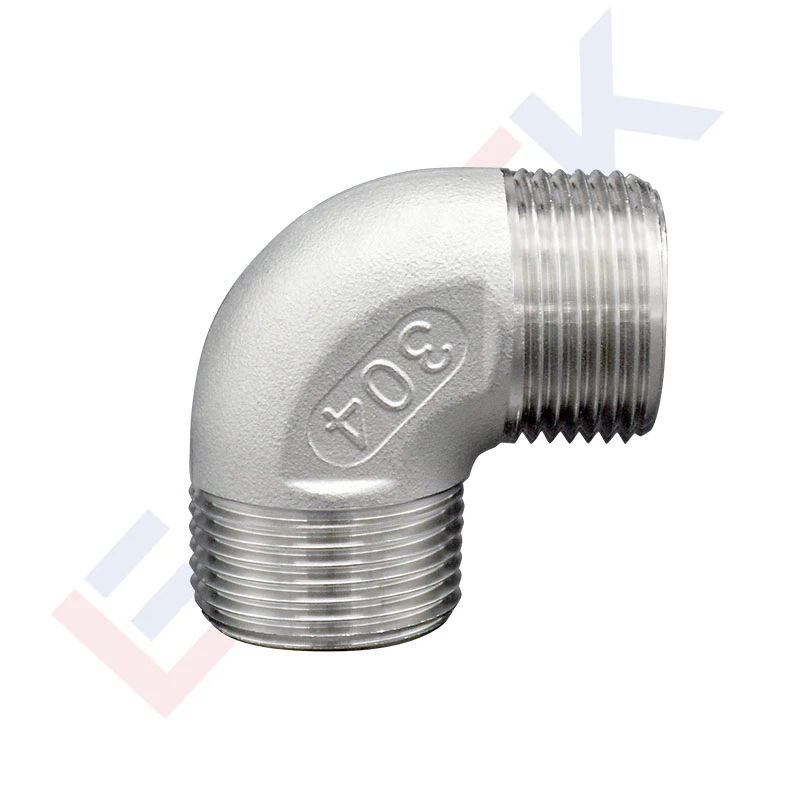
Precision 90 Degree and 45 Degree Street Elbows
Every industrial batch leaves our facility with fully certified Material Test Reports (MTRs according to EN 10204 3.1) and full pneumatic/hydrostatic pressure testing logs to guarantee operational safety.
Contact the LEADTEK engineering group today to acquire exact CAD submittals, chemical resistance matrix sheets, or an immediate technical quotation for your upcoming piping blueprint.